职称:副研究员、博士生导师
研究领域:卫星导航与电离层模型、空间天气
邮箱:acheng@buaa.edu.cn
个人主页:acheng.space
办公地址:学院路校区图书馆东配楼103
教育/工作经历:
2018.05-至今,北京航空航天大学
2015.03-2018.04,地球空间信息技术协同创新中心/武汉大学卫星导航定位技术研究中心, 博士后
2010.09-2014.11,同济大学,测绘与地理信息学院, 博士
2012.10-2014.01,Miami University, The Department of Electrical and Computer Engineering, 联合培养博士生
2007.09-2010.07,长安大学,地质工程与测绘学院, 硕士
2003.09-2007.07,长安大学,地质工程与测绘学院, 学士
研究领域:
电离层模型、空间天气、卫星导航定位、数据处理方法
研究项目:
1. 面向中高低轨导航卫星系统的三维电离层广播模型研究与优化(国家自然科学基金面上项目,项目编号:42474037)
2. 高精度可信导航增强服务信号关键技术(国家重点研发计划课题,项目编号:2022YFB3904402)
3. 全球大规模GNSS电离层数据集(国家空间科学数据中心青年开放课题,课题编号:NSSDC2301001)
4. 超高分辨率地球电离层模型(中国科学院重大科技基础设施开放共享课题,课题编码:2023-EL-PT-000387)
5. 电离层模型(国家超级计算天津中心“天河”青索计划——地球科学领域专项基金)
6. 基于子午工程流星雷达观测的风场时空特征分析与建模研究(空间天气学国家重点实验室开放课题)
7. 自适应全球电离层三维数学模型的建立及优化反演方法研究(国家自然科学基金青年项目,项目编号:41804026)
获奖情况:
2023,青年测绘科技创新人才
2022,中国(广东)中山海外博士博士后创新赛优胜奖
2021,卫星导航定位科技进步奖特等奖
科研成果:
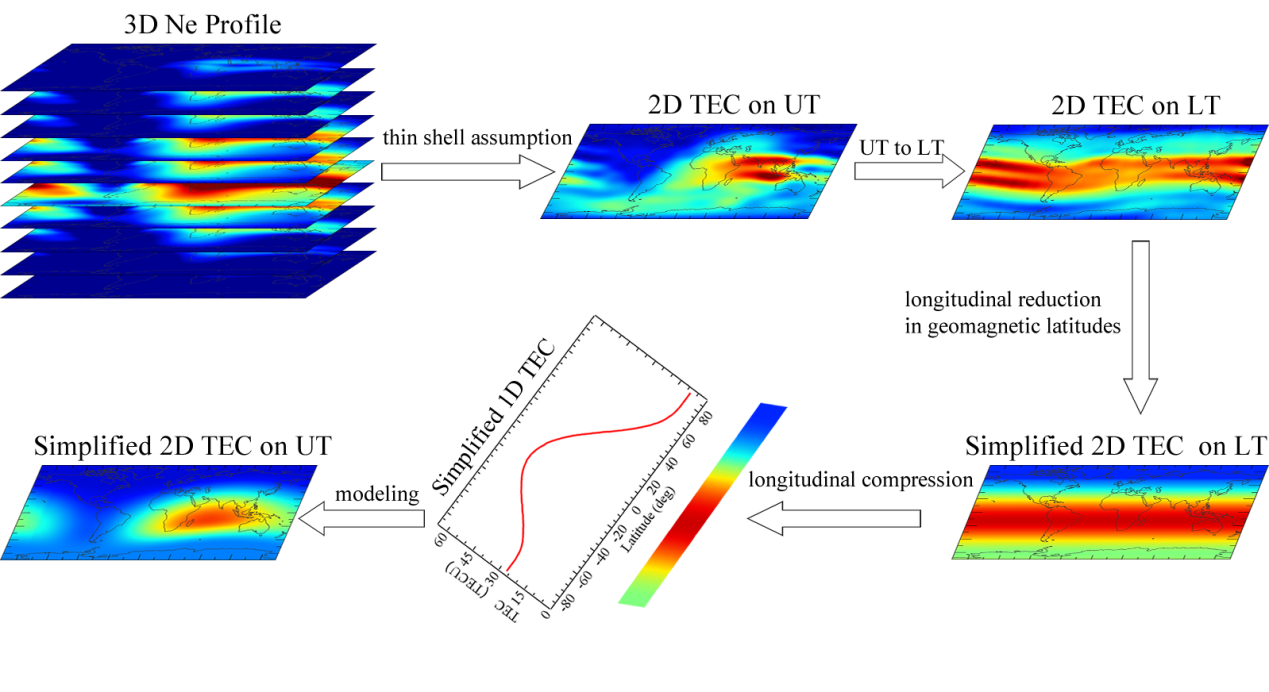
1. 提出一种适用于卫星导航系统的全球电离层广播模型,兼顾精度、效率和易用性,为GNSS电离层延迟提供了全新的解决方案。详见 https://doi.org/10.1109/TAES.2021.3103259
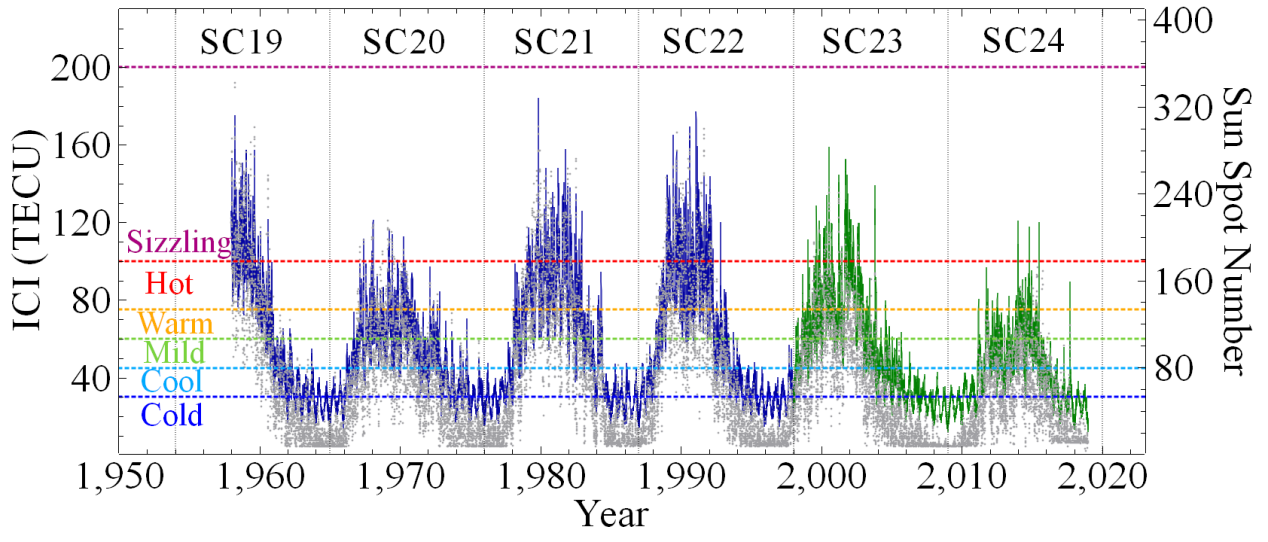
2. 提出电离层天气指数(Ionospheric Climate Index, ICI)表征电离层状态。根据ICI数值大小划分为寒冷、冷、温和、温暖、热和炎热六个等级来形容不同级别的电离层天气。详见 https://doi.org/10.1029/2020SW002596
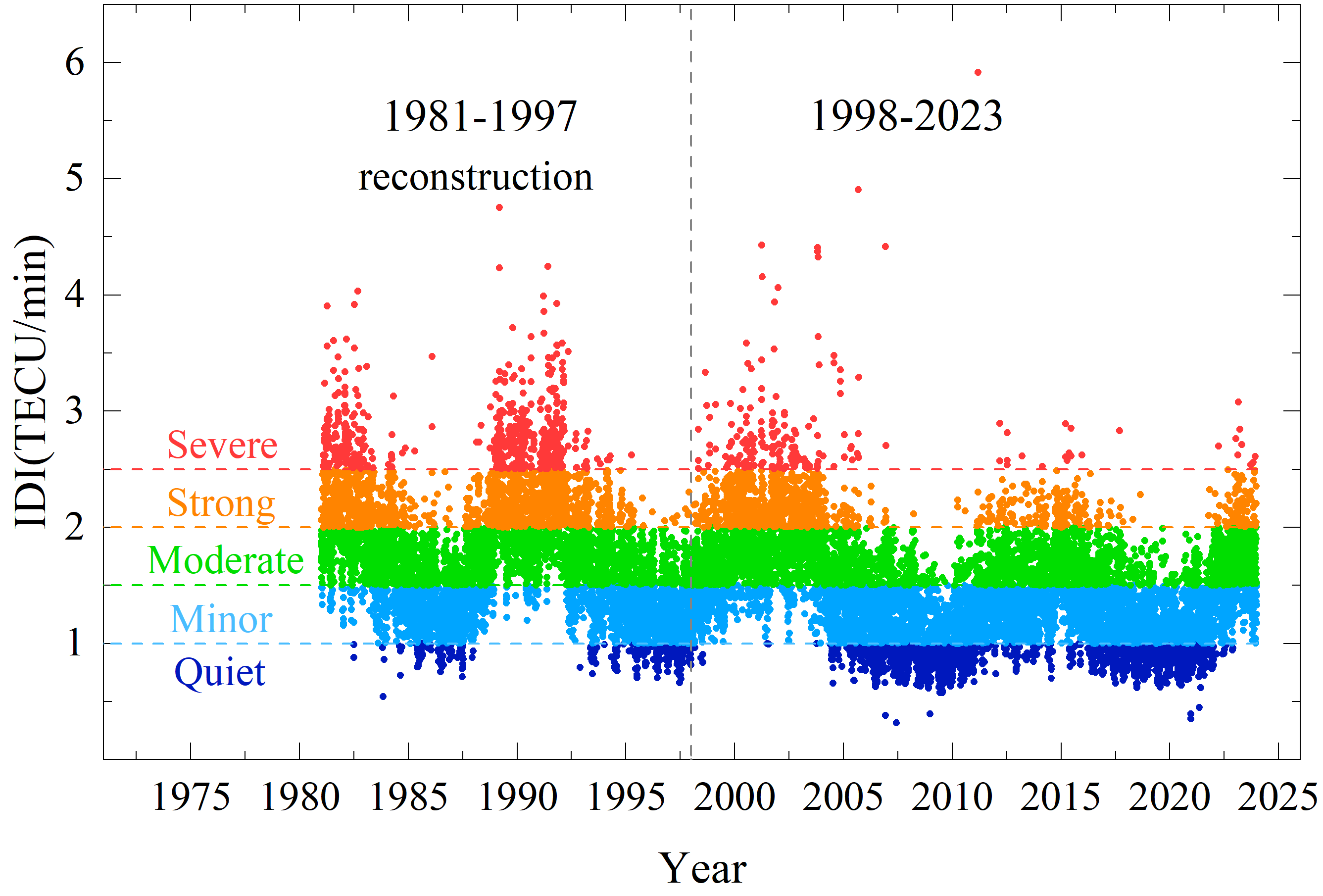
3. 提出电离层扰动指数(Ionospheric Disturbed Index, IDI)表征电离层扰动状态。根据IDI数值大小划分为平静、微扰、扰动、强烈扰动、严重扰动五个等级形容不同程度的电离层扰动。详见 https://doi.org/10.1029/2025SW004445
发表论文:
1. K. Xue, C. Shi, C. Wang*, Forecasting global ionospheric TEC maps via ensemble learning with feature-engineered reconstruction, Chinese Journal of Aeronautics (2025), https://doi.org/10.1016/j.cja.2025.104026
2. K. XUE, C. SHI, Z. WANG, C. WANG*, DHA-UNet: Dual hybrid attentional UNet model for global ionospheric prediction during geomagnetic storm, Chinese Journal of Aeronautics (2025), https://doi.org/10.1016/j.cja.2025.103755
3. Wang, C., Min, X., & Hu, H. (2025). An ionospheric disturbed index based on ROTI. Space Weather, 23, e2025SW004445. https://doi.org/10.1029/2025SW004445
4. He, L., Zhu, Q. & Wang, C*. Analysis of the global spatiotemporal characteristics of ionospheric noontime bite-outs. Satell Navig 6, 11 (2025). https://doi.org/10.1186/s43020-025-00164-x
5. C. Wang*, K. Xue and C. Shi, An Optimized Model with Encoder-Decoder ConvLSTM for Global Ionospheric Forecasting, IEEE Geoscience and Remote Sensing Letters, 2025, https://doi.org/10.1109/LGRS.2025.3565645
6. Liu, J., C. Wang*, K. Xue and C. Shi, Evaluating the Performance of Klobuchar, NeQuickG and BDGIM Models During the Ascending Phase of Solar Cycle 25, Advances in Space Research, 2025, https://doi.org/10.1016/j.asr.2025.04.066
7. Xue, K., Shi, C., & Wang, C.*. RA-ConvLSTM: Recurrent-architecture attentional ConvLSTM networks for prediction of global total electron content. Space Weather (2025), 23, e2024SW004173. https://doi.org/10.1029/2024SW004173
8. Xue K, Shi C, Wang C. Deep Learning Based UNet for Global Ionospheric Forecasting[C]//2024 14th International Symposium on Antennas, Propagation and EM Theory (ISAPE). IEEE, 2024: 1-4 doi:10.1109/ISAPE62431.2024.10840593.
9. Xue K, Shi C, Wang C. Machine Learning of CatBoost for Global Vertical Total Electron Content Prediction[C]//2024 Cross Strait Radio Science and Wireless Technology Conference (CSRSWTC). IEEE, 2024: 1-3 doi:10.1109/CSRSWTC64338.2024.10811627.
10. Jia L, Wang C. Spatial Characteristics Analysis of Higher-Order Terms in the Ionosphere Based on Optimization Method[C]//2024 Cross Strait Radio Science and Wireless Technology Conference (CSRSWTC). IEEE, 2024: 1-4 doi:10.1109/CSRSWTC64338.2024.10811472.
11. He, L., Zhu, Q., Wang, C.*, Comprehensive Analysis of the equatorial ionization anomaly based on global ionospheric maps with a high spatiotemporal resolution, Advances in Space Research (2024), https://doi.org/10.1016/j.asr.2024.06.047
12. K. Xue, C. Shi and C. Wang*, ATS-UNet: Attentional 2-D time sequence UNet for global ionospheric one-day-ahead prediction, IEEE Geoscience and Remote Sensing Letters, https://doi.org/10.1109/LGRS.2024.3398205
13. 许波波, 王成*, 张雨露, 文援兰, 何丽娜, 李桢. COSMIC电离层掩星反演模拟及星座优化[J]. 空间科学学报. doi: 10.11728/cjss2024.01.2022-0072
14. Xue K, Shi C, Wang C. Global Ionospheric Total Electron Content Forecasting Model Using Temporal Convolutional Network[C]//2023 Cross Strait Radio Science and Wireless Technology Conference (CSRSWTC). IEEE, 2023: 01-03 doi:10.1109/csrswtc60855.2023.10426823.
15. Liu Y, Wang C, Ou M. Validation of IRI-2012 and IRI-2016 Models Over Oceans Using Jason Data[C]//2023 Cross Strait Radio Science and Wireless Technology Conference (CSRSWTC). IEEE, 2023: 01-03 doi:10.1109/csrswtc60855.2023.10427168.
16. Liu Y, Wang C. Analysis of Relaxation Factor Function for Ionospheric Tomography[C]//2023 Cross Strait Radio Science and Wireless Technology Conference (CSRSWTC). IEEE, 2023: 1-3 doi:10.1109/csrswtc60855.2023.10427544.
17. Ou, M., D. Fan, C. Wang* and L. He, A simulation study of the Argo program-enhanced global ionospheric modeling, Advances in Space Research, 2023, https://doi.org/10.1016/j.asr.2023.11.005
18. Shi, C., Guo, S., Fan, L*., ..., Wang, C. et al. GSTAR: an innovative software platform for processing space geodetic data at the observation level. Satell Navig 4, 18 (2023). https://doi.org/10.1186/s43020-023-00109-2
19. Shi, C., Xue, K., Wang, C.*, Predicting Global Ionospheric TEC Maps Using Gaussian Process Regression, Advances in Space Research (2023), https://doi.org/10.1016/j.asr.2023.06.036
20. Cheng Wang, Shanshan Xia, Lei Fan*, Chuang Shi, Guifei Jing, Ionospheric climate index as a driving parameter for the NeQuick model, Advances in Space Research, 2023, 71(1), 216-227. https://doi.org/10.1016/j.asr.2022.08.069
21. 施闯, 肖云, 范磊, 郑福, 王成, 黄志勇, 李桢*. 导航卫星辐射光压建模进展及发展趋势[J]. 航空学报, 2022, 43(10): 527389-527389.
22. Xia, G., Zhang, F., Wang, C., & Zhou, C.* (2022). ED-ConvLSTM: A Novel Global Ionospheric Total Electron Content Medium-term Forecast Model. Space Weather, 20, e2021SW002959. https://doi.org/10.1029/2021SW002959
23. C. Wang, T. Zhang, L. Fan*, C. Shi and G. Jing, "A Simplified Worldwide Ionospheric Model for Satellite Navigation," in IEEE Transactions on Aerospace and Electronic Systems, vol. 58, no. 1, pp. 391-405, Feb. 2022, https://doi.org/10.1109/TAES.2021.3103259
24. 施闯, 周凌昊, 范磊, 张卫星, 曹云昌, 王成, 肖锋, 吕国卿, 梁宏. 2022. 利用北斗/GNSS观测数据分析“21·7”河南极端暴雨过程. 地球物理学报, 65(1): 186-196. https://doi.org/10.6038/cjg2022P0706
25. Fan, L., Wang, C.*, Guo, S. et al. GNSS satellite inter-frequency clock bias estimation and correction based on IGS clock datum: a unified model and result validation using BDS-2 and BDS-3 multi-frequency data. J Geod 95, 135 (2021). https://doi.org/10.1007/s00190-021-01583-9
26. Wang, C., Li, Y., Wu, J., Fan, L., Wang, Z., Zhou, C.*, et al. (2021). An ionospheric climate index based on GNSS. Space Weather, 19, e2020SW002596. https://doi.org/10.1029/2020SW002596
27. Forsythe,V.V.*, Azeem,I., Crowley, G.,Makarevich, R. A., & Wang, C. (2020).The global analysis of the ionospheric correlation time and its implications for ionospheric data assimilation. Radio Science, 55, e2020RS007181. https://doi.org/10.1029/2020RS007181
28. Z. Wang, K. Xue, C. Wang*, T. Zhang, L. Fan, Z. Hu, C. Shi, G. Jing. Near real-time modeling of global ionospheric vertical total electron content using hourly IGS data, Chinese Journal of Aeronautics, 2020. https://doi.org/10.1016/j.cja.2020.07.023
